
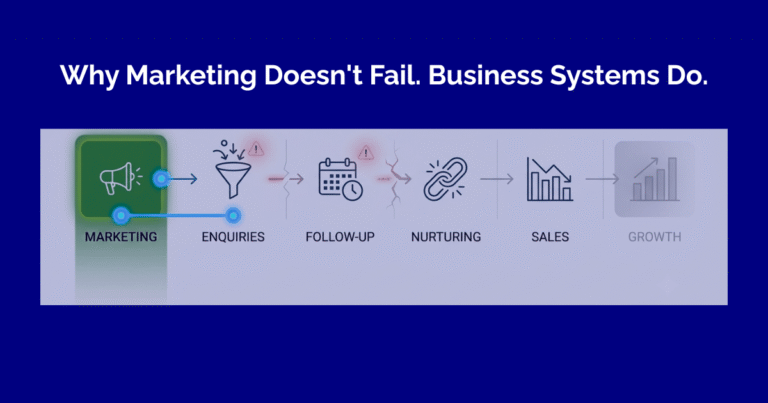
Marketing isn’t broken. Weak business systems are. Learn why leads don’t convert and how integrated business growth systems drive predictable growth.
Table of Contents
ToggleThe Myth Everyone Believes
When business growth slows, sales pipelines begin to shrink, or enquiries suddenly dry up, one conclusion usually follows almost immediately:
“Our marketing isn’t working.”
It is an understandable reaction. Marketing is the most visible growth function in any business. Advertisements, websites, social media campaigns, exhibitions, email campaigns, and promotional activities are all highly visible—and when business results disappoint, they naturally become the first suspects.
The immediate response is often to replace the marketing agency, increase advertising budgets, redesign the website, or demand more content on social media. The assumption is simple: if leads aren’t converting into sales, marketing must have failed.
But what if that assumption is wrong?
What if marketing is doing exactly what it is supposed to do—creating awareness, generating enquiries, and bringing prospects into your business—but the real problem lies somewhere else?
In my experience, businesses rarely fail because of poor marketing alone. More often, marketing exposes weaknesses that already exist within the organisation. Weak positioning, inconsistent follow-up, poor enquiry management, unclear value propositions, and disconnected customer journeys quietly limit growth long before marketing ever enters the picture.
So before increasing your marketing budget or changing your agency, it may be worth asking a different question:
What if marketing isn’t failing at all? What if your business systems are?
What Business Owners Usually Do
The moment business growth begins to slow, most leaders do what any responsible decision-maker would do—they look for ways to accelerate growth. The intention is never wrong. In fact, it often comes from a genuine desire to solve the problem quickly before it affects revenue, market share, or team morale.
The challenge is that the solutions usually focus on doing more, rather than understanding why the existing efforts aren’t producing the expected outcomes.
A company may decide to redesign its website, hoping a fresh look will improve conversions. Others increase their advertising budget, believing more visibility will generate more customers. Some replace their marketing agency in search of better results, while others intensify their social media activity, participate in more exhibitions, or expand the sales team.
Individually, none of these decisions is incorrect. Each can contribute to growth when implemented at the right time and for the right reasons.
However, they all share one common assumption—that the problem lies at the top of the funnel, where leads are generated.
Very few organisations pause to ask a more fundamental question:
What happens after a lead is generated?
Is every enquiry acknowledged promptly? Is there a structured follow-up process? Do prospects receive the information they need to make an informed decision? Is anyone accountable for moving an enquiry from initial interest to a successful sale?
These questions are less visible than advertising campaigns or website redesigns, but they often determine whether marketing investments produce meaningful business outcomes.
Because generating opportunities is only the beginning of the customer journey.
Marketing may already be doing its job exceptionally well. The real challenge may be that the business isn’t fully prepared to convert those opportunities into customers.
Why Good Marketing Still Doesn't Deliver Results
Marketing has one primary responsibility: to attract attention and generate opportunities. Whether through digital campaigns, search engines, social media, exhibitions, referrals, or content marketing, its role is to bring potential customers to your doorstep.
But that is only the beginning of the customer journey.
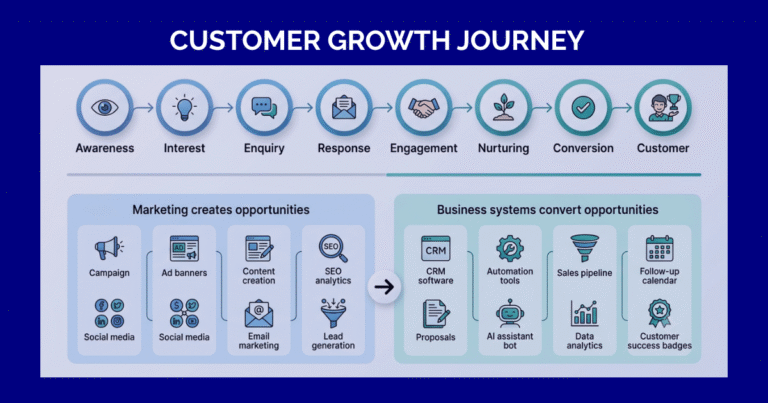
What happens after a prospect visits your website, downloads your brochure, fills out an enquiry form, scans a QR code at an exhibition, or calls your office? That is where the real test begins—and where many businesses unknowingly lose the momentum that marketing has created.
Imagine yourself as a prospective customer evaluating your business for the first time. Does your website inspire confidence and clearly communicate why someone should choose you over the competition? Is your value proposition compelling, or does it simply list products and features?
When an enquiry arrives, is it acknowledged within minutes or does it remain unattended for hours—or even days? Is every enquiry systematically recorded, assigned to the right person, and tracked until closure? Are prospects who aren’t ready to buy today nurtured through periodic communication, or are they forgotten after the first interaction?
For businesses that operate through dealers, distributors, or channel partners, another critical question emerges: Are they equipped with the right tools, information, and processes to convert enquiries into customers? Even the strongest marketing campaign can lose its impact if the last mile of customer engagement is inconsistent.
Finally, how many organisations truly measure what happens after a lead is generated? Do they know their enquiry-to-opportunity conversion rate? Their opportunity-to-sale conversion rate? Their average response time? Or the reasons why prospects choose not to buy?
Without these answers, businesses often mistake symptoms for causes. They see disappointing sales and assume the marketing campaign has failed, when in reality the campaign may have delivered exactly what it promised—qualified opportunities.
The uncomfortable truth is this: marketing creates opportunities; business systems convert them. Marketing opens the door, but it is the strength of your business processes that determines whether a prospect walks through it.
This is why marketing so often gets blamed for problems it didn’t create. Marketing simply shines a light on the inefficiencies, gaps, and disconnects that already exist within the business. When those systems are weak, even exceptional marketing struggles to deliver exceptional results.
Why Marketing Teams Get Blamed
When business growth slows, someone inevitably starts looking for the reason. And because marketing is one of the most visible functions connected to growth, it often becomes the first place where questions are raised.
The logic seems reasonable. If marketing is responsible for generating awareness and leads, then fewer sales must mean marketing isn’t generating enough—or isn’t generating the right kind of opportunities.
But inside most organisations, the reality is more complex.
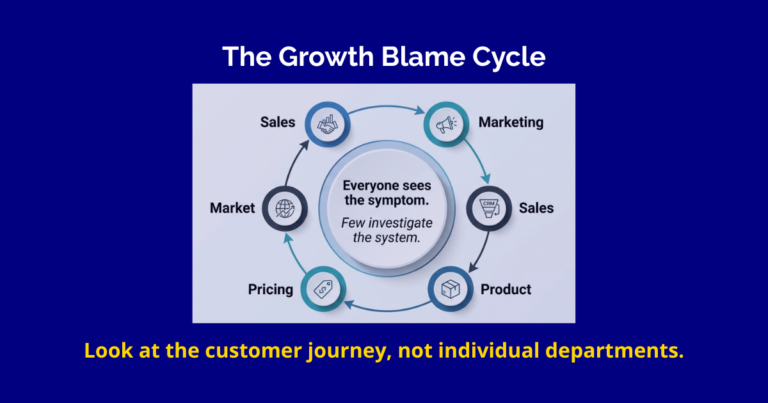
Sales teams may argue that marketing isn’t providing enough qualified leads. Marketing teams may respond that sales isn’t following up effectively. Sales may point towards product limitations or competitive disadvantages. Product teams may highlight pricing pressures, while management may question whether the market itself has become more difficult.
Each perspective may contain some truth.
The problem begins when these functions are evaluated in isolation.
This need for integration is increasingly recognised in B2B organisations. McKinsey research found that 89% of respondents believe marketing and sales need to work closely together, more so than ever before.
A prospect doesn’t experience your business as separate departments. They experience one continuous journey—from the first advertisement they see to the website they visit, the salesperson they speak with, the proposal they receive, the follow-up that happens, and ultimately, the decision they make.
A weakness anywhere along that journey can affect the final outcome.
Yet when sales numbers decline, businesses often focus on the most visible symptom rather than tracing the entire journey to identify where opportunities are actually being lost.
This isn’t necessarily a failure of leadership, marketing, or sales. It is often a failure to look at growth as an interconnected business system.
Marketing cannot compensate indefinitely for weak positioning. Sales cannot compensate for poor lead management. And more leads cannot solve a broken conversion process.
Everyone sees the symptom. Few investigate the system.
And that brings us to the most important question:
Where are the real bottlenecks that prevent marketing opportunities from becoming business growth?
The Real Bottlenecks
If marketing is generating interest but growth is still disappointing, the next step isn’t automatically to generate more leads. It is to identify where existing opportunities are being lost.
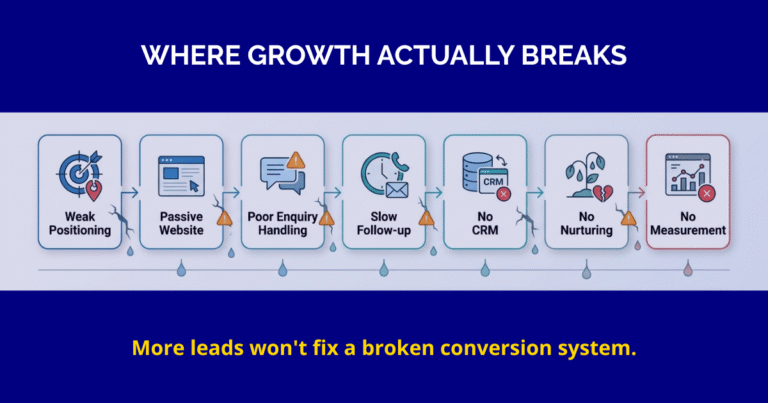
In many businesses, the real bottlenecks sit somewhere between attracting a prospect and converting that prospect into a customer.
Weak Positioning
A prospect discovers your company—but cannot quickly understand why they should choose you.
Your communication may explain what you sell, but does it clearly communicate why you are different? When your value proposition sounds similar to everyone else’s, price often becomes the easiest basis for comparison.
Marketing can increase visibility. It cannot compensate for unclear positioning.
A Website Without Purpose
A modern-looking website is not necessarily an effective website.
Many corporate websites function primarily as digital brochures. They describe the company, display products and list specifications—but give visitors little reason to take the next step.
An effective website should build credibility, answer important buyer questions and guide prospects towards a meaningful action—whether that is requesting a consultation, downloading information, finding a dealer or submitting an enquiry.
A website should not merely inform. It should move the customer journey forward.
Poor Enquiry Handling
A lead arrives. What happens next?
Who owns it? Who assigns it? Who ensures that someone responds? And who remains accountable until the opportunity is closed or genuinely lost?
Without a defined enquiry-management process, leads can easily move between marketing, sales, regional teams and channel partners without clear ownership.
The campaign generated the opportunity. The process lost it.
Slow Follow-up
Customer interest has a shelf life.
A prospect who enquires today may also be evaluating three competitors. If your first meaningful response arrives two days later, the buying conversation may already have progressed elsewhere.
Speed of response isn’t merely an operational metric. It is part of the customer experience.
No CRM or Lead-Tracking System
When enquiries are scattered across spreadsheets, emails, WhatsApp conversations and individual salespeople’s phones, visibility disappears.
Management cannot easily determine which opportunities are active, which require follow-up, or why others were lost.
More importantly, valuable organisational learning disappears with them.
A CRM or structured lead-tracking system creates something marketing alone cannot provide: continuity and accountability across the customer journey.
No Lead Nurturing
Not every prospect is ready to buy immediately.
Some need internal approvals. Others are comparing alternatives, waiting for budgets, or simply aren’t ready to make a decision yet.
When businesses stop communicating after one or two follow-ups, potentially valuable opportunities quietly go cold.
Lead nurturing keeps the relationship alive until the prospect is ready to move forward.
No Measurement
Finally, what isn’t measured is difficult to improve.
Which channels generate enquiries? How quickly are they contacted? How many become qualified opportunities? How many convert into customers? What does each lead cost?
Without these numbers, management is forced to diagnose growth problems through assumptions rather than evidence.
And that is the larger point.
Weak positioning, ineffective websites, poor enquiry handling, delayed follow-up, missing CRM systems, absent nurturing and inadequate measurement are not marketing failures.
They are business system failures—and increasing the marketing budget won’t fix them.
When Customer Interest Doesn't Translate into Sales

Consider a farm machinery manufacturer introducing a walk-behind rice transplanter in an Indian market where farmers have traditionally relied on manual transplanting.
The proposition is compelling. The machine can reduce dependence on increasingly scarce farm labour, improve timeliness of transplanting and bring greater consistency to field operations.
The launch generates considerable interest. Farmers gather around demonstrations at exhibitions and field events. Videos attract attention. Website traffic increases. Dealers begin receiving enquiries.
Everything appears to be working.
But introducing a new technology is different from selling a familiar product. Interest quickly gives way to questions.
What if the mat nursery doesn’t develop properly? Will machine transplanting affect yield? Who will train us in nursery preparation? Will the machine work under our field conditions? What happens if it breaks down during the short transplanting window? Does the investment make economic sense for my farm?
These aren’t merely product objections. They are barriers to adoption.
Now imagine that the website provides specifications but doesn’t adequately address these concerns.
Some dealers confidently explain the complete solution, while others focus primarily on machine features and price.
Some interested farmers receive demonstrations; others receive quotations.
Those who say, “I’ll think about it,” aren’t systematically nurtured with field results, farmer experiences, demonstration videos or relevant information.
Three months later, awareness is high, and enquiries are healthy—but sales remain below expectations.
Was the marketing unsuccessful?
Not necessarily.
Marketing did what it was expected to do: it created awareness, curiosity and opportunities. What was missing was the business system required to convert curiosity into confidence—and confidence into adoption.
For any new product or technology, particularly one that requires customers to change established practices, advertising alone cannot drive adoption. Product education, demonstrations, dealer capability, customer support, structured follow-up, nurturing and measurement must work together.
Marketing generated the interest. The business system had to convert it.
Key Takeaways
Marketing is an important driver of business growth, but it is only one part of the growth journey. Generating awareness, attracting prospects and creating enquiries have limited value if the rest of the organisation isn’t equipped to convert those opportunities into customers.
Sustainable growth depends on what happens across the entire customer journey—from positioning and digital presence to enquiry management, sales follow-up, nurturing, conversion and measurement. A weakness at any stage can reduce the effectiveness of everything that comes before it.
This is why simply increasing marketing activity doesn’t always improve business results. More advertising may generate more leads, but it can also send more opportunities into a system that is already struggling to manage them.
The businesses that achieve more consistent and predictable growth don’t necessarily market more. They build integrated systems in which marketing, sales, customer engagement, channel partners and business processes work towards the same outcome.
The real question, therefore, isn’t simply, “Is our marketing working?”
It is:
“Is our entire business system working together to convert market opportunities into sustainable growth?”
Look Beyond Marketing - Build Business Growth Systems
When business growth slows, it is tempting to look for a quick solution. Change the marketing agency. Increase the advertising budget. Redesign the website. Post more content. Generate more leads.
Sometimes, one of those actions may indeed be necessary.
But before investing more time, money and resources into marketing, it is worth examining what happens to the opportunities you are already creating.
Does your positioning give customers a compelling reason to choose you? Does your digital presence build confidence? Are enquiries captured, assigned and followed up consistently? Are prospects nurtured until they are ready to buy? Do your sales teams and channel partners have what they need to convert opportunities? And are you measuring where prospects are being lost?
Because marketing cannot operate in isolation.
Even the best campaign cannot compensate indefinitely for gaps elsewhere in the customer journey. When positioning, marketing, sales, customer engagement and measurement operate as disconnected activities, growth becomes inconsistent and difficult to predict.
So before asking, “What should we do differently in marketing?”, ask a more fundamental question:
“Is my business ready to convert every opportunity that marketing creates?”
That question changes the conversation.
It shifts the focus from generating more activity to improving the system behind growth.
Because sometimes, marketing isn’t broken at all.
The business system around it is.