
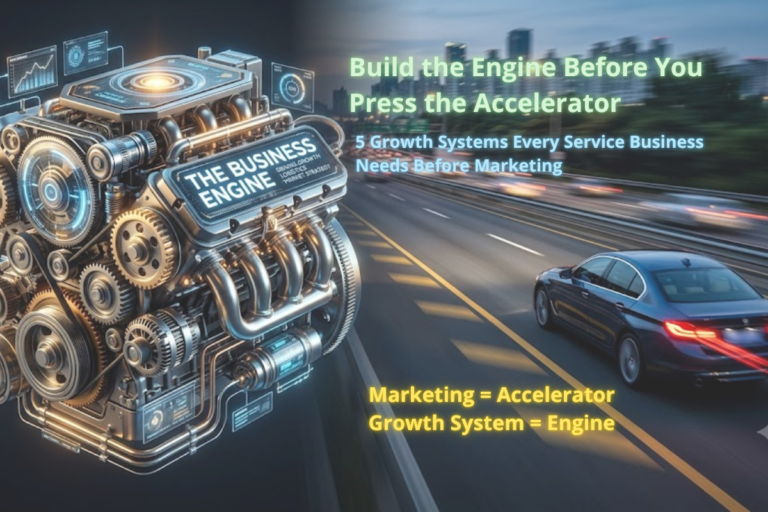
Growth Systems for Service Businesses are the foundation of sustainable growth. Discover 5 key systems to build before investing more in marketing.
Table of Contents
ToggleIntroduction: The Costly Mistake Most Service Businesses Keep Repeating
The Marketing Trap
When business growth slows, most service business owners instinctively look at marketing as the solution. They increase advertising budgets, become more active on social media, redesign their websites, or hire marketing agencies, believing that greater visibility will naturally generate more customers and revenue.
While marketing is essential, it is often expected to solve problems that originate elsewhere. Marketing can create awareness and generate enquiries, but it cannot fix weak positioning, inconsistent sales processes, poor customer experiences, or operational inefficiencies. When these underlying issues remain unresolved, increasing marketing efforts simply amplifies existing business weaknesses instead of creating sustainable growth.
More Leads, Same Problems
Many service businesses assume that more leads automatically result in more business. Unfortunately, reality is often very different. Increased visibility may generate more enquiries, but without well-defined business systems, those opportunities quickly slip away. Leads are not followed up consistently, proposals are delayed, customer interactions vary, and potential clients lose confidence before making a decision.
The problem is not the lack of leads—it is the lack of systems to manage them effectively. Instead of accelerating growth, increased visibility often exposes operational weaknesses that were previously hidden, leaving business owners frustrated despite investing more in marketing.
A Different Perspective
Business growth is not determined by marketing alone. Marketing amplifies what already exists—it brings more people to your business, creates opportunities, and starts conversations. Whether those opportunities become loyal customers depends on the systems working behind the scenes.
Businesses that achieve sustainable growth don’t rely solely on better marketing; they build Growth Systems that consistently attract, convert, serve, and retain clients. In simple terms, marketing amplifies your business, but systems determine whether that growth is sustainable.
Why Marketing Alone Doesn't Create Sustainable Business Growth
What Marketing Actually Does
Marketing is often misunderstood. Many business owners view it as the solution to every growth challenge, when its actual role is much more specific. Marketing’s primary purpose is to attract the right audience and create opportunities for business.
Effective marketing creates:
- Awareness – It introduces your business to potential customers.
- Visibility – It ensures your business is seen by the people who matter.
- Enquiries – It motivates prospective customers to express interest.
- Conversations – It opens the door to meaningful business discussions.
These are essential outcomes because no business can grow if potential customers are unaware of its existence. However, attracting attention is only the beginning of the customer journey, not the end.
When Marketing Starts Failing
Marketing appears to fail when the business is unable to convert opportunities into customers. The symptoms are familiar. Leads don’t convert into clients. A website receives visitors but fails to inspire confidence. Follow-ups become inconsistent, allowing prospects to lose interest. Customers interact once but never return or refer others.
These issues are often blamed on marketing, but they usually originate elsewhere. Marketing has successfully generated interest; the business simply lacks the systems needed to nurture, convert, and retain those opportunities. As marketing brings in more enquiries, these operational weaknesses become increasingly visible.
Marketing Isn't the Problem
When business owners don’t achieve the desired results, marketing is often the first thing they question. In reality, marketing has simply done its job—it has created awareness, generated enquiries, and initiated conversations. The real challenge begins after that.
If leads are not converted, follow-ups are inconsistent, customer experiences vary, or service delivery lacks consistency, the issue lies within the business, not the marketing. Sustainable business growth is achieved when effective marketing is supported by well-designed Growth Systems that consistently convert opportunities into satisfied, long-term clients.
The Hidden Foundation: What Is a Growth System?
Defining a Growth System
The term Growth System is often misunderstood. Many people associate it with software, automation tools, or a Customer Relationship Management (CRM) platform. While technology can support business growth, it is not the growth system itself.
The concept of building businesses through structured processes and continuous improvement has long been advocated by management thinkers such as W. Edwards Deming.
A Growth System is an integrated business framework that connects every stage of the customer journey—from attracting the right audience to converting prospects into clients, delivering a consistent customer experience, and encouraging repeat business and referrals. It ensures that every business function works together towards a common objective: sustainable growth.
Instead of relying on individual efforts or isolated marketing campaigns, a Growth System creates repeatable processes that produce predictable outcomes. Marketing, sales, customer onboarding, service delivery, and client retention are no longer independent activities; they become interconnected parts of a single business ecosystem.
Businesses don’t scale because they work harder. They scale because they build systems that consistently deliver value, irrespective of who performs the task.
The Four Stages of Sustainable Growth
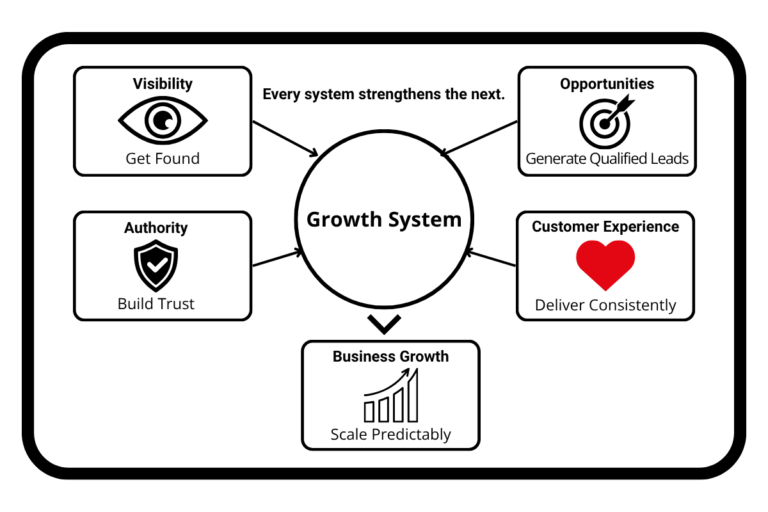
Sustainable business growth does not happen by chance. It follows a logical progression where each stage strengthens the next. At KarmaClicks Digital, this philosophy is represented through a simple yet powerful Growth Framework.
It begins with Visibility. Your ideal customers must first discover your business before they can consider buying from you. However, being visible is only the starting point.
Visibility must then evolve into Authority. Through consistent branding, valuable content, social proof, and a professional digital presence, businesses build credibility and earn the trust of prospective clients.
Authority naturally creates Opportunities. As trust grows, enquiries become more qualified, conversations become more meaningful, and prospects are more willing to engage with your business.
When these opportunities are supported by well-designed business systems, they result in Business Growth—not just in terms of increased revenue, but also through improved customer satisfaction, stronger referrals, repeat business, and the ability to scale with confidence.
This progression—from Visibility to Authority, Opportunities, and ultimately Business Growth—forms the foundation of the KarmaClicks Growth Systems philosophy.
Growth Happens Through Systems, Not Activities
Many businesses mistake activity for progress. They regularly post on social media, run advertising campaigns, redesign their websites, or launch promotional offers. While these activities may create short-term momentum, they rarely produce consistent, long-term growth when they operate in isolation.
A Growth System connects every business function into a unified process. Marketing attracts the right audience. Sales converts enquiries into customers. Standard Operating Procedures (SOPs) ensure consistency. Customer experience builds trust. Reviews and referrals generate new opportunities, creating a continuous cycle of sustainable growth.
The difference is simple. Activities produce isolated results, whereas systems produce predictable outcomes. Businesses that focus only on doing more remain dependent on constant effort. Businesses that build connected systems create a strong foundation for sustainable growth and long-term scalability.
Five Critical Growth Systems For Service Business Before Scaling Marketing
Every successful service business is built on a strong foundation of interconnected systems. Marketing may generate enquiries, but sustainable business growth depends on how effectively those enquiries are managed, converted, and transformed into long-term customer relationships. Before investing more in marketing, every service business should evaluate whether the following five systems are firmly in place.
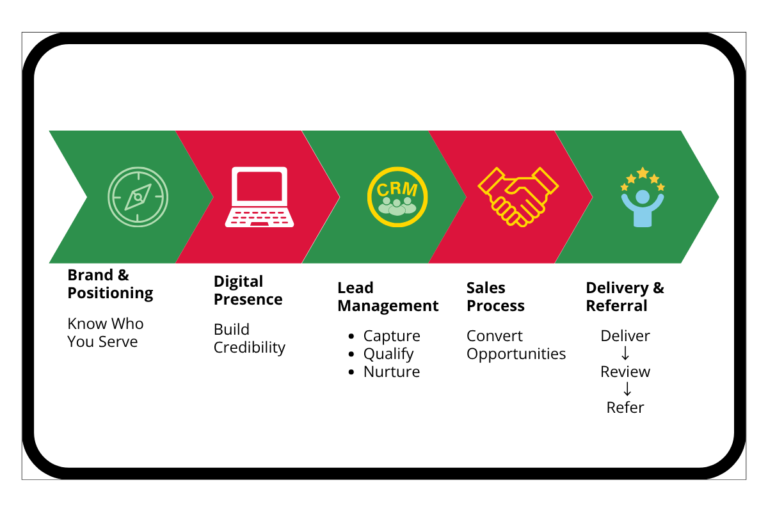
System 1 – Brand & Positioning System
In today’s competitive marketplace, customers are overwhelmed with choices. They don’t choose the business that shouts the loudest—they choose the one that communicates the clearest value. This is where a strong Brand & Positioning System becomes essential.
Your brand is far more than a logo or colour palette. It defines who you serve, the problems you solve, what differentiates you from competitors, and why customers should trust you. Effective positioning ensures that your ideal clients immediately understand your expertise and the value you bring.
When your messaging is consistent across every customer touchpoint, your business becomes memorable and credible. Without clear positioning, even the most aggressive marketing campaigns struggle to produce meaningful results because prospects remain confused about why they should choose you over countless alternatives.
Clarity builds confidence, and confident customers are far more likely to initiate business conversations.
System 2 – Digital Presence System
Your digital presence is often the first impression a prospective client has of your business. Before they call, email, or schedule a meeting, they are likely to visit your website, search for your Google Business Profile, read customer reviews, or check your LinkedIn page. Every digital touchpoint influences their perception and buying decision.
A professional website establishes credibility and clearly communicates your expertise, services, and value proposition. An optimized Google Business Profile improves local visibility and helps potential clients discover and contact your business. Customer reviews and testimonials provide social proof, reassuring prospects that others have trusted and benefited from your services. A well-maintained LinkedIn profile or company page reinforces professional credibility, especially in the B2B and service sectors.
Most importantly, these platforms must present a consistent brand experience. Your messaging, visual identity, contact information, and customer promise should remain consistent across all channels. Consistency builds familiarity, and familiarity builds trust.
An effective Digital Presence System ensures that when marketing attracts attention, every online interaction strengthens your credibility and moves prospects one step closer to becoming customers.
System 3 – Lead Capture & Qualification System
Generating enquiries is only half the battle. What happens after someone expresses interest in your business often determines whether you win or lose the opportunity. A well-designed Lead Capture & Qualification System ensures that every enquiry is acknowledged, assessed, and guided through a structured process.
Every lead should be captured through clearly defined channels such as your website, landing pages, Google Business Profile, social media, or referral network. Once captured, the lead should be qualified to understand the prospect’s needs, budget, decision-making authority, and readiness to proceed. This enables your team to focus on genuine opportunities instead of treating every enquiry the same.
A structured follow-up process, supported by a CRM ollowing established lead management best practices or an organised lead management system, ensures that no potential customer is forgotten. Timely responses, meaningful conversations, and consistent nurturing significantly improve conversion rates.
Businesses don’t lose opportunities because they lack leads—they lose them because they lack a system to manage those leads effectively.
System 4 – Sales & Client Experience System
A prospect becomes a customer only when confidence outweighs uncertainty. This is where a well-defined Sales & Client Experience System plays a crucial role. Every interaction should reassure the prospect that they are making the right decision.
The journey begins with a structured discovery process that focuses on understanding the client’s business challenges rather than immediately proposing solutions. This is followed by timely and consistent follow-ups, ensuring that enquiries remain engaged throughout the decision-making process.
A professionally presented proposal should clearly communicate the recommended solution, expected outcomes, scope of work, timelines, and commercial terms. Once the proposal is accepted, a systematic client onboarding process creates a positive first impression by collecting the necessary information, defining expectations, and establishing clear communication channels.
When every step is documented and consistently executed, prospects experience professionalism, transparency, and reliability. This builds customer confidence, shortens the sales cycle, improves conversion rates, and lays the foundation for a long-term business relationship.
System 5 – Delivery & Referral System
Winning a client is an achievement; retaining that client and earning their recommendation is the true measure of a successful business. An effective Delivery & Referral System ensures that every client receives a consistent, high-quality experience that encourages long-term relationships.
Exceptional service delivery begins with clearly defined processes and Standard Operating Procedures (SOPs) that maintain quality regardless of who delivers the service.
This approach closely aligns with internationally accepted Quality Management System principles. Proper documentation keeps projects organised, improves communication, and ensures commitments are fulfilled on time. Satisfied clients naturally become your strongest source of reviews and testimonials, strengthening your credibility and influencing future buying decisions.
A consistently positive client experience also generates referrals and repeat business, two of the most cost-effective sources of sustainable growth. Instead of constantly chasing new customers, businesses with strong delivery systems create loyal advocates who willingly recommend their services to others.
Sustainable growth is not built by acquiring more customers alone; it is built by consistently delivering value that transforms customers into long-term partners and brand ambassadors.
The Real Cost of Ignoring Growth Systems
Marketing Becomes Expensive
Without well-defined Growth Systems, businesses often respond to slowing sales by increasing their marketing spend. While this may generate more enquiries, the absence of structured processes means that many opportunities are lost before they become paying customers. As a result, the cost of acquiring each customer increases, conversion rates decline, and the return on investment (ROI) from marketing continues to fall.
Instead of solving the growth problem, businesses end up spending more to achieve the same—or even lower—results. Marketing becomes increasingly expensive because it is trying to compensate for weaknesses that should have been addressed through better business systems.
Founder Dependency Increases
In the absence of documented systems, the business gradually becomes dependent on its founder. Every important decision, client interaction, approval, and problem eventually requires the owner’s involvement. While this may seem manageable in the early stages, it soon becomes the biggest obstacle to growth.
As the business expands, the founder becomes the bottleneck. Teams struggle to work independently, decisions are delayed, and customers receive inconsistent experiences. Instead of building a scalable business, the owner ends up creating a business that cannot function effectively without them.
Growth Becomes Unpredictable
Businesses without Growth Systems rarely achieve consistent performance. Some months bring strong revenues, while others fall short of expectations. Teams struggle because processes are unclear and responsibilities are not well defined. As the business grows, inconsistencies in execution begin to affect customer satisfaction and overall service quality.
Growth should never depend on luck, individual effort, or last-minute firefighting. It should be driven by repeatable systems that deliver consistent outcomes. When every stage of the customer journey is supported by well-designed processes, businesses become more predictable, more resilient, and better equipped to scale with confidence.
A Practical Framework to Assess Your Business
Before investing more in marketing, take a step back and evaluate whether your business is prepared for growth. A simple self-assessment can help you identify where the real constraints lie. Rate your business honestly across the following five dimensions.
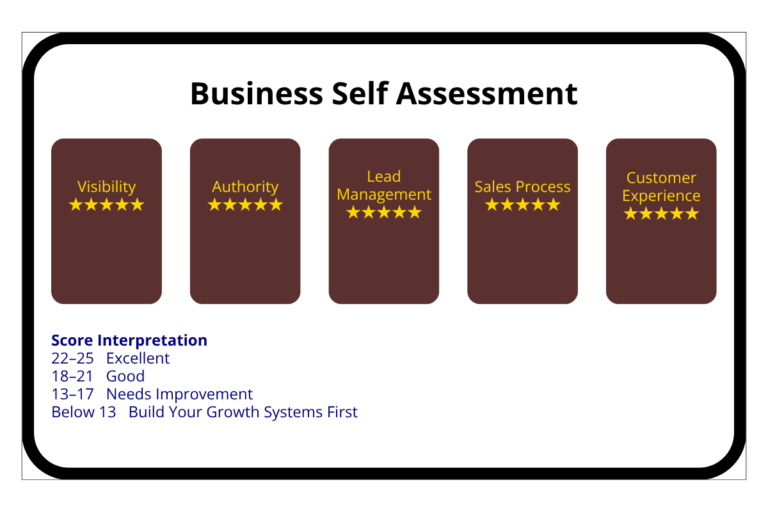
Visibility
Can your ideal customers easily find your business through your website, Google Business Profile, LinkedIn, social media, or other relevant channels?
Authority
Does your digital presence build confidence through clear positioning, valuable content, testimonials, and consistent branding?
Lead Management
Is every enquiry captured, qualified, followed up, and tracked through a structured process, or do leads slip through the cracks?
Sales Process
Do you have a defined process for discovery meetings, proposal presentations, follow-ups, and client onboarding that consistently converts prospects into customers?
Customer Experience
Do your clients receive a consistent, high-quality experience that encourages repeat business, positive reviews, and referrals?
If you identify weaknesses in any of these five areas, focus on strengthening them before increasing your marketing investment. Marketing can generate more opportunities, but only strong Growth Systems can convert those opportunities into sustainable business growth.
From Freelancer Thinking to Agency Thinking
Every business reaches a stage where simply executing more tasks no longer creates meaningful growth. Delivering individual marketing services, completing projects, or launching campaigns can certainly generate results, but sustainable business success demands a broader perspective. It requires thinking beyond individual activities and focusing on how every part of the business works together.
Businesses don’t scale by publishing more social media posts or running more advertising campaigns. They scale by building repeatable systems that consistently attract opportunities, convert prospects into customers, deliver exceptional experiences, and create loyal advocates. When every stage of the customer journey is connected through well-defined processes, growth becomes predictable rather than accidental.
This philosophy has fundamentally shaped the way I think about business. Instead of asking, “How can marketing generate more leads?”, I now ask, “What systems must exist for a business to grow consistently, regardless of market conditions or individual effort?” That shift in thinking has influenced not only the solutions I design but also the way I partner with clients. My objective is not merely to help businesses market themselves better, but to help them build a stronger foundation for long-term, sustainable growth.
Conclusion: Build the Engine Before Pressing the Accelerator
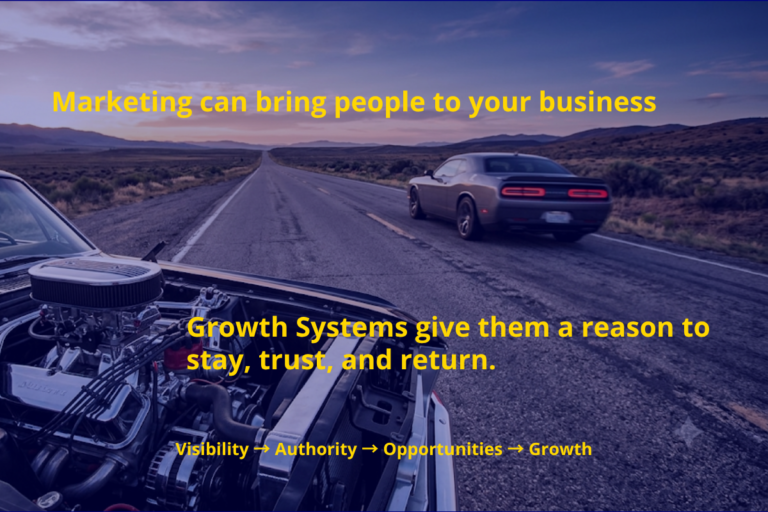
Marketing Is an Accelerator
Marketing is one of the most powerful investments a business can make—but only when the business is prepared to capitalise on the opportunities it creates. It can increase visibility, generate enquiries, and attract prospective customers. However, without strong business systems, even the best marketing campaigns struggle to deliver sustainable results.
Sustainable Growth Is Designed
Businesses that achieve long-term success don’t depend on luck, constant hustle, or isolated marketing activities. They invest in building repeatable systems that consistently attract the right audience, convert enquiries into customers, deliver exceptional experiences, and create loyal advocates. Sustainable growth is never accidental—it is intentionally designed through disciplined processes and continuous improvement.
Final Thought
Marketing can bring people to your business. Growth Systems give them a reason to stay, trust, and return.
If your business is investing in marketing but not achieving the results you expected, it may be time to look beyond marketing itself. Evaluate your business systems, identify where opportunities are being lost, and focus on strengthening the foundation before increasing your marketing investment.
If you’d like an objective perspective, a Growth Opportunity Discussion can help uncover the gaps that may be limiting your business growth and identify practical, system-driven improvements to support sustainable success.