
Table of Contents
ToggleBecause in the new digital world, visibility isn’t about shouting louder — it’s about staying connected.
The Visibility Crisis Most Small Businesses Don’t See Coming
You post on social media.
You boost an ad once in a while.
You even built a decent-looking website.
And yet, growth feels random.
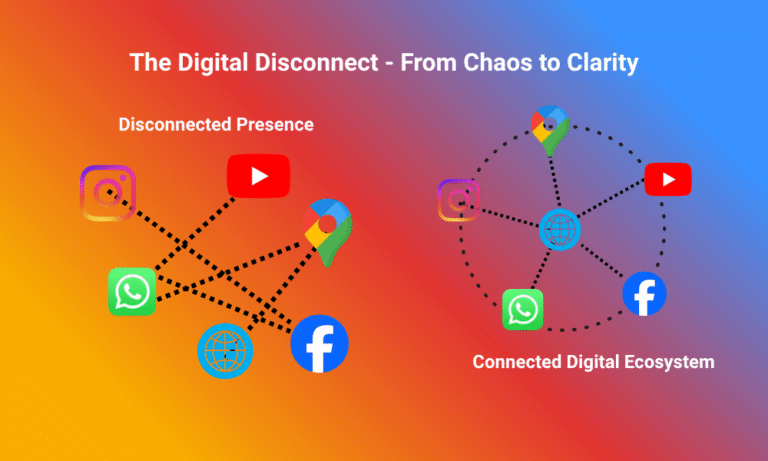
If you’ve ever wondered why your business isn’t attracting steady leads or repeat customers despite your best efforts, you’re not alone. The truth is — most small businesses today are trapped in what I call “The Digital Disconnect.”
Each marketing effort — your Instagram post, your Google listing, your WhatsApp broadcast — exists in isolation. They don’t talk to each other. There’s no system connecting them. And that’s the biggest reason your digital presence feels busy… but not effective.
As we move into 2026, digital marketing isn’t about being everywhere — it’s about being connected. The businesses that will thrive are the ones that treat their online presence as a single, living system — not a collection of random tools.
This is where the idea of a digital ecosystem for small business becomes a game changer. It’s not just a marketing framework; it’s the new foundation of business growth.
A well-built digital ecosystem makes your business visible, credible, and discoverable — consistently. It ensures that every digital action you take contributes to a single, clear outcome: attracting and converting the right customers, automatically.
In this blog, we’ll explore why every small business needs a digital ecosystem in 2026 — what it really means, the problems it solves, and how you can start building yours today.
The Digital Reality of 2026: Why Old Tactics No Longer Work
The digital landscape in 2026 looks nothing like it did just a few years ago. The rules have changed — not slowly, but dramatically. Artificial intelligence is reshaping how people search, social media algorithms are prioritizing trust over trends, and customers expect instant clarity before making decisions.
In 2026, your first impression is almost always digital. Whether someone is looking for a doctor, an architect, or a café, their journey starts online — with a quick search, a few seconds of scanning, and a snap judgment about whether you seem credible enough to contact.
Here’s the challenge: most small businesses are still playing by 2019’s rules.
They’re relying on scattered tactics — a Facebook page here, a Google ad there, and maybe a website that hasn’t been updated in years. It’s digital activity without digital alignment.
And that’s exactly why even hardworking entrepreneurs remain invisible.
The truth is, customers no longer interact with your brand in a straight line. They don’t move neatly from “see ad → click → buy.” Instead, they weave through a maze of touchpoints — checking your reviews, browsing your Instagram, scanning your website, and reading your posts — all before deciding if they can trust you.
If these touchpoints are inconsistent or disconnected, your brand feels confusing — and confused brands rarely convert.
That’s why building a digital ecosystem for small businesses has become a necessity, not a luxury.
It’s the only way to ensure that all your digital pieces — your website, Google Business Profile, social platforms, and content — are synchronized to deliver one clear message and one seamless experience.
In 2026, visibility isn’t about spending more on ads. It’s about building a connected presence that makes your business easy to find, trust, and choose.
Because in a world overflowing with noise, connection beats competition.
What Exactly Is a Digital Ecosystem?
Let’s clear the fog — what do we actually mean by a digital ecosystem for small businesses?
In simple terms, a digital ecosystem is the interconnected network of all your online touchpoints — your website, Google Business Profile, social media pages, email marketing, online reviews, and content — all working together in harmony to build visibility, credibility, and trust.
Think of it like your business’s digital nervous system. Every signal — every post, search result, review, or ad — runs through it. When everything is connected and consistent, your business responds faster, looks more professional, and grows more predictably.
Now imagine this:
Your Google listing points people to your website.
Your website tells a clear story about your brand.
Your blog posts and videos link back to your social media.
Your social media content drives engagement and reviews.
And your email system keeps nurturing those leads automatically.
That’s not marketing chaos — that’s marketing clarity.
A well-designed digital ecosystem doesn’t just attract attention; it amplifies your authority across every platform. It ensures that when someone discovers you anywhere online, they get the same experience — consistent visuals, consistent messaging, consistent credibility.
Most importantly, it saves you time and effort. Instead of managing five different digital channels separately, your ecosystem makes them work together like one intelligent machine.
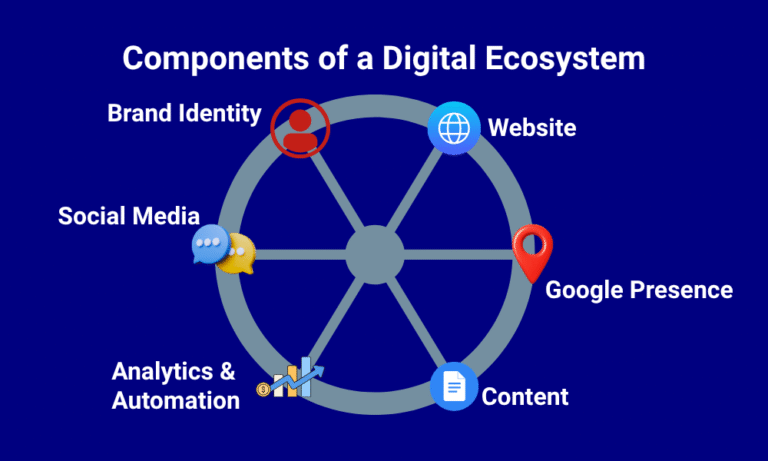
At its core, your digital ecosystem is made up of six connected elements:
1️⃣ Brand Identity – who you are and what you stand for.
2️⃣ Website – your headquarters and home base.
3️⃣ Google Presence – your discoverability engine.
4️⃣ Social Media – your community and communication hub.
5️⃣ Content System – your trust-building engine.
6️⃣ Analytics & Automation – your intelligence layer for decisions.
Together, they form a self-sustaining loop that attracts, nurtures, and converts the right customers — even when you’re not online.
In short, a digital ecosystem for small businesses isn’t about using more tools — it’s about connecting the right ones in the right order to create momentum and growth.
The Big Problems a Digital Ecosystem Solves
Most small businesses today don’t fail because of a bad product or poor service.
They fail because they are digitally disconnected.
They have fragments of presence — a Facebook page that’s rarely updated, a website no one visits, a Google listing with missing details, and a few customer reviews scattered online. None of it works together. And in 2026, that’s the fastest way to become invisible.
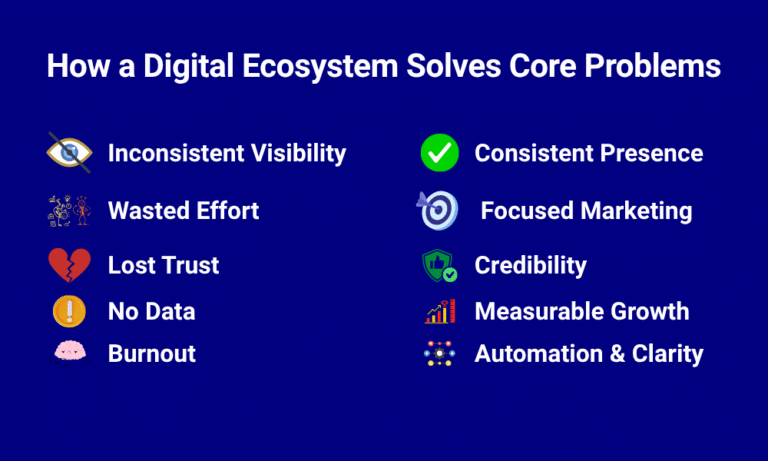
Here are the biggest problems a digital ecosystem for small businesses helps solve:
Inconsistent Visibility
You might post on social media today, skip a week, and run a small ad next month — but online visibility doesn’t work that way anymore.
Inconsistent presence confuses both the audience and search algorithms.
A connected ecosystem ensures your brand stays visible everywhere that matters — not through constant effort, but through consistent connection. Your Google profile, social handles, and website start reinforcing one another automatically, keeping you discoverable even when you’re not actively posting.
Wasted Effort
Many small business owners work hard — but in the wrong direction.
They spend time creating content or boosting posts without knowing if those actions connect to a clear goal.
When your ecosystem is in place, everything you do — a post, a blog, a video, or even a review — contributes to the same outcome: awareness, engagement, or conversion.
No wasted motion. No duplicated effort. Just intelligent alignment.
Lost Trust
Customers judge credibility faster than ever.
When your website says one thing, your social page looks outdated, and your Google listing has old photos — it sends a silent message: “This business isn’t professional.”
A digital ecosystem fixes this by creating consistency — the same brand voice, tone, and visuals across every platform. It builds trust before you even speak to the customer.
No Data or Direction
Without a connected system, you can’t measure what’s working.
You’re left guessing which marketing effort brings results.
A proper ecosystem integrates your analytics — so you can see where leads come from, which content performs best, and what needs improvement. That’s when decisions become data-driven, not emotional.
Burnout and Confusion
Running marketing in fragments is exhausting.
You’re constantly switching between tools, chasing trends, and still feeling behind.
An integrated digital ecosystem for small businesses simplifies your digital life.
It replaces overwhelm with clarity and transforms your online presence into a system that quietly, predictably, and efficiently grows your business.
In short, the digital ecosystem for small businesses doesn’t just solve your marketing problems — it restores your control, confidence, and consistency.
It lets you focus on what you do best — while your online presence does the heavy lifting in the background.
The 5 Pillars of a Strong Digital Ecosystem
A strong digital ecosystem for small business isn’t built overnight.
It’s built on five interconnected pillars — each one reinforcing the other to create a solid, sustainable foundation for growth.
Let’s explore them one by one.
Clarity of Identity – Who You Are Online
Everything begins with clarity.
Before websites, posts, or ads, you must define who you are digitally.
Your digital identity is more than your logo or tagline — it’s the story, tone, and message that makes your business recognizable across every platform. It answers three crucial questions:
- What problem do you solve?
- Who do you solve it for?
- What makes you different?
When these are clear, your ecosystem aligns around them.
Your visuals, copy, and content start to speak one language — your brand’s language.
👉 Pro Tip: Create a one-page brand statement that summarises your promise, audience, and voice. Refer to it before posting anything online.
Your Website as Headquarters – The Digital Home Base
Your website is not just a digital brochure — it’s your business headquarters online.
Every platform you use should lead people back here.
In your ecosystem, your website acts as the command center — housing your key information, offers, and contact options. It’s also your credibility hub: the place where visitors decide whether to trust you.
A good website for small businesses in 2026 should be:
- Fast-loading (especially on mobile)
- Clear in message — who you are and what you do, within 5 seconds
- Visually consistent with your brand identity
- Designed to convert — with CTAs like “Book a Call”, “Get a Quote”, or “Learn More”
👉 Pro Tip: Treat your website as your digital headquarters, not a one-time project. Keep it active — add blogs, testimonials, and updates regularly.
Connected Channels – Make Every Platform Work Together
A disconnected presence kills momentum.
Your Instagram bio doesn’t link to your website.
Your Google profile shows old timings.
Your YouTube videos don’t mention your brand.
That’s digital chaos.
When you build a connected digital ecosystem for a small business, every touchpoint reinforces the other.
Your website links to your social handles.
Your posts mention your Google profile.
Your reviews show up on your homepage.
Your content drives people into your CRM or WhatsApp.
Everything flows in a loop — website ↔ Google ↔ Social ↔ Email ↔ Content ↔ Analytics.
👉 Pro Tip: Once a month, audit your ecosystem. Click through your links like a customer would. Fix any dead ends.
Content That Builds Trust – Your Voice in the Digital World
In a world full of noise, content is the signal that builds trust.
When your ecosystem is healthy, your content is not random — it’s intentional.
It educates, engages, and establishes authority.
The most effective content types for small businesses are:
- Educational: Tips, FAQs, insights that position you as an expert.
- Credibility: Testimonials, before–after stories, case studies.
- Connection: Personal experiences, brand stories, and team moments.
Each post or blog becomes another digital handshake — quietly saying, “You can trust me.”
👉 Pro Tip: Focus on consistency over frequency. One meaningful post every week beats ten rushed ones.
Discoverability – Being Found When It Matters Most
Finally, the strongest ecosystem is worthless if no one can find it.
Discoverability is where visibility turns into opportunity.
In 2026, being discoverable means appearing where your customers are looking — on Google, Maps, and even AI-driven search results.
Here’s how your ecosystem boosts discoverability:
- Google Business Profile: Keep it verified, updated, and review-rich.
- SEO-Optimized Website: Use clear keywords that your target audience actually searches for.
- Online Reviews: Encourage feedback and respond professionally.
- Local SEO: Add your area, service category, and contact details across platforms.
When all these parts connect, your ecosystem does the marketing for you.
You show up when customers are ready to buy — and because your brand looks credible, they choose you over others.
 Pro Tip: Don’t chase algorithms; serve humans. Google’s AI now rewards relevance and authenticity over keyword stuffing.
A powerful digital ecosystem for a small business is like a flywheel —
Once it starts turning, it gains momentum and requires less manual effort over time.
Every platform supports the next, and together they create visibility, trust, and consistent growth.
Why 2026 Is the Tipping Point
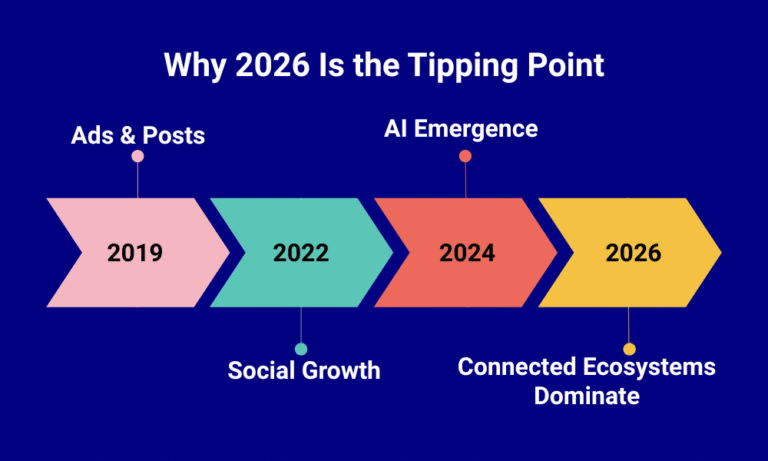
Every few years, the digital world shifts — and businesses that adapt early win big.
2026 is one of those turning points.
Here’s why.
Artificial intelligence is changing how people discover, evaluate, and engage with businesses. Search is becoming conversational — powered by voice assistants and AI summaries that only show credible, connected brands. Paid ads are more expensive, organic reach is shrinking, and audiences are smarter than ever.
In short, random visibility won’t work anymore.
What people — and algorithms — are now rewarding is connection and consistency.
If your online presence feels disjointed, you’ll be filtered out — not by competitors, but by the platforms themselves.
But when you’ve built a digital ecosystem for a small business, every touchpoint supports the other. Google recognizes your consistent NAP (name, address, phone) data. Social posts link to your optimized website. Reviews boost local ranking. Blog content fuels SEO.
Suddenly, your business doesn’t just appear online — it appears everywhere that matters.
Another significant shift in 2026 is a change in customer psychology.
People are no longer impressed by flashy ads; they’re reassured by authentic presence. They expect to see real stories, real reviews, and a brand that feels alive and trustworthy across platforms.
That’s exactly what a connected ecosystem delivers. It tells one cohesive story — from your Instagram bio to your Google page to your website contact form — and that story builds confidence.
2026 isn’t just another year in marketing evolution; it’s the year of digital credibility.
And credibility doesn’t come from noise — it comes from connection.
Small businesses that invest in building a digital ecosystem now will dominate local searches, appear in AI-driven recommendations, and convert trust into transactions.
The rest will keep wondering why their great products never got the visibility they deserved.
How to Start Building Your Digital Ecosystem
By now, you know why your business needs a digital ecosystem in 2026.
The next question is — how do you actually build one?
The good news?
You don’t need a massive team or a complicated tech setup.
You just need a clear roadmap and consistent action.
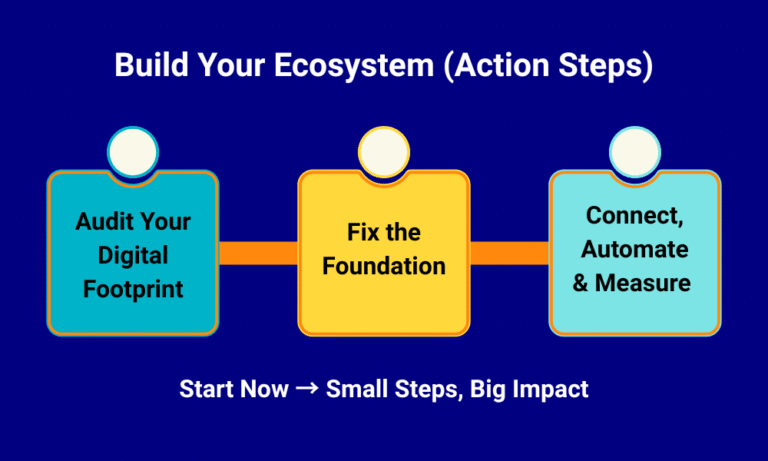
Here’s a simple three-step starting point to get you moving in the right direction:
Step 1: Audit Your Current Digital Footprint
Before building anything new, look at what already exists.
Search your business name on Google.
Check your social profiles, website, listings, and reviews.
Ask yourself:
- Is my brand identity consistent everywhere?
- Are my contact details updated?
- Is my website current, fast, and mobile-friendly?
- Do my posts and content reflect my core message?
This audit will show you where the gaps are — and that’s where your ecosystem-building begins.
Step 2: Fix the Foundation
Every strong digital ecosystem for small businesses begins with clarity and consistency.
Start by refreshing your brand message and visual identity. Then, ensure your website communicates clearly who you are, what you offer, and how people can reach you.
Once that’s done, connect your Google Business Profile and social pages back to your website.
Make your branding — colours, tone, and messaging — uniform across platforms.
That alone builds instant trust and discoverability.
Step 3: Connect, Automate & Measure
The final step is connection.
Link every platform — website, social media, email marketing, Google Business — into one seamless flow.
Use simple automation tools to collect inquiries, send responses, or track performance.
And most importantly, measure everything.
See where your leads come from, which posts bring traffic, and what content drives engagement.
That’s how your ecosystem becomes smarter every month.
At KarmaClicks Digital, we call this framework EkoSys — a guided system that helps small businesses build their own connected digital ecosystem without the tech overwhelm.
You can start small, build gradually, and let your ecosystem evolve — just like your business does.
Conclusion: From Scattered to Structured
The digital world isn’t slowing down — and neither should your business.
In 2026, success won’t belong to those who post the most; it’ll belong to those who are most connected.
A digital ecosystem for small businesses is no longer a “nice-to-have.”
It’s the invisible engine behind discoverability, credibility, and sustainable growth.
It transforms your marketing from scattered efforts into a structured system — one that works even when you don’t.
It ensures every click, post, and review points back to a single purpose: building trust and attracting the right customers.
And that’s the real shift — from chasing visibility to creating discoverability.
Start small. Audit your presence. Fix your foundation. Connect your tools.
The earlier you begin, the faster your digital presence compounds — and the harder it becomes for competitors to catch up.
At KarmaClicks Digital, we help small businesses do exactly that through our structured approach called EkoSys — a guided path to building your own connected digital ecosystem, step by step.
Because in this new era, great businesses deserve to be found, not just followed.
So don’t stay invisible — build your ecosystem.
Your future customers are already searching for you.
It’s time they finally discover you.
Nice article about digital eco system. Contains good information about the need for digital ecosystem in future
very informative. i need to do the audit
Very informative and guiding